The retreat of the Aral Sea and subsequent development of the Aralkum desert is one of the most impressive examples for desertification of our time. The work sheet “Aralkum – A Lake Disappears” demonstrates the development of the region in the past 10 years using ISS videos, satellite imagery and background information about the societal and economic processes. The students slip into the role of scientists researching the area and predicting the Aralkum’s future development with the “Aralkum – A Lake Disappears”- app.
http://columbuseye.rub.de/unterricht/
While air pollution in central Europe is well documented and many counteractions have been taken by politics, light pollution is barely considered by the public. This teaching material contains satellite images and an ISS video demonstrating the effects of light pollution. Two neighbouring regions with different approaches to night-time lighting are compared, both in regards to reasons and impacts. Natural conditions and settlement structures are discussed in this context, as well.
http://columbuseye.rub.de/english/
The work sheet explains the formation of tropical cyclones by taking the example of typhoon Maysak, which afflicted the Phillipines on 5th of April, 2015. Schematic representations, ISS videos, and weather maps illustrate the formation and structure of tropical cyclones. The work sheet is enriched by a so-called Augmented Reality application. Combined with the paper-based worksheet, the App “Eye of the Cyclone” allows pupils to watch typhoon Maysak live on their smartphones.
http://columbuseye.rub.de/english/
The work sheets contain material about the formation and classification of various types of deserts, both from the climate and the geomorphological perspective. The video “Desert of the Earth” shows the various desert types from the view of the International Space Station ISS. Pupils learn to classify those types with climate graphs and other materials. The topic of desertification is subsequently demonstrated by the example of the Aral Sea and the massive impact of the process both on humans and the environment.
More information on http://columbuseye.rub.de/english/
5 Seiten, zur Verfügung gestellt von coleye am 27.11.2019
When opening the tool “Canada”, the ISS-panorama will appear, showing the region Saskatchewan and the almost fully frozen Tobin Lake. Moving eastwards you will spot the Lake Winnipeg as well as partly ice- and snow-covered regions until you reach Fjord Saguenay in the east, located north of Québec. A video of formerly 9 minutes – the time it took for the ISS to fly over this region – was used to create this panorama.
http://columbuseye.rub.de/english/#Observatorium
When opening the tool “South America”, the ISS-panorama will appear. It shows the coast of Chile in the west, bordering the pacific as well as the Andes Mountains with snow cover and the pampas, when navigating inland. The panorama was created out of a video of a 5-minute overflight of the ISS crossing the depicted area.
http://columbuseye.rub.de/english/#Observatorium
The ISS flight above Western Africa shows an unique portrait of the Earth’s biggest desert: the Sahara. It shows the huge dimensions of the enormous and hot drylands. But it also includes the more vivid Savannas in the adjacent neighborhood. While there is nearly no life in the Sahara, you can find here seasonal blooming regions and even agriculture. Perhaps, you can detect the Eye of Africa or the ship graveyard of Nouadhibou.
http://columbuseye.rub.de/english/#Observatorium
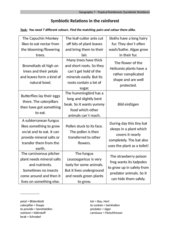
Geo bili Arbeitsblatt, in dem verschiedene Wechselbeziehungen im TR vorgestellt werden. Es sind nicht alles echte symbiotische Beziehungen, aber zumindest aufeinander beruhende :-).
1 Seite, zur Verfügung gestellt von trixbix am 10.03.2017






 Mehr von coleye: